Page 1 of 2
timing question
Posted: Fri Apr 12, 2013 4:06 pm
by bazza3004
Hi can anyone tell me if timing my ignition to 17 btdc what this would be in mil using a dial gauge on the piston crown.
Re: timing question
Posted: Fri Apr 12, 2013 4:30 pm
by Grumpy225
bazza3004 wrote:Hi can anyone tell me if timing my ignition to 17 btdc what this would be in mil using a dial gauge on the piston crown.
Depends, on the crank rod, stroke and piston type.
There is a good diagram in the back of stickys book on timing with different cranks.
I like to use the dial guage to find TDC and then confirm it against the timing disc. If Multiple methods yield the same result then something must be right.
Re: timing question
Posted: Fri Apr 12, 2013 5:23 pm
by Ken Tucky
Re: timing question
Posted: Fri Apr 12, 2013 5:52 pm
by Pepot
I think it's easier with a timing disc,but since I didn´t like the ones I found in diferent websites I decided to do my own one:
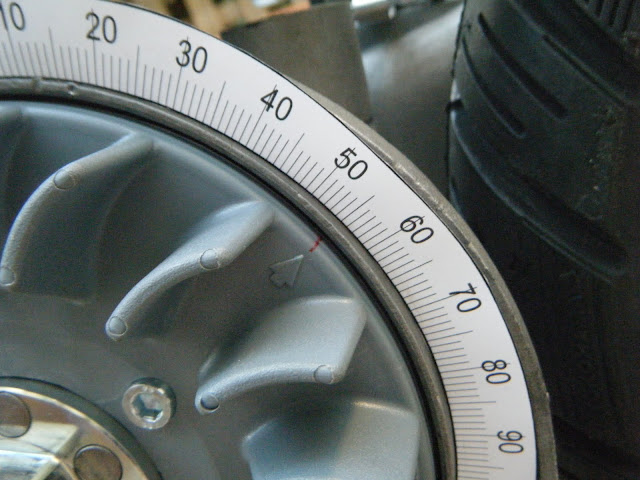
In my opinion, reading in this disc its easier.I also use it to find the TDC by the positive stop method described in the stiky's book.
You just have to print this:

to the proper size,and cut it so it fits tight onto your maghousing.I have even checked the firing point with a strobe without removing the disc,wich results useful in retard-advance ignitions.
Cheap and more accurate than a dial gauge for findig the right firing point!!!
Re: timing question
Posted: Fri Apr 12, 2013 8:22 pm
by jason frost
Pepot wrote:
Cheap and more accurate than a dial gauge for findig the right firing point!!!
Cheap yes More accurate ?? I dont think so

but if your happy
Re: timing question
Posted: Fri Apr 12, 2013 9:30 pm
by fairspares
I agree with you Jason, a dial gauge is far better at finding the dwell centre true tdc/bdc than a timing disc.
Re: timing question
Posted: Fri Apr 12, 2013 9:46 pm
by Adam_Winstone
Each to their own... my dial simply gathers dust as I don't like them, hate the strip down involved, find them less accurate because of the 'roll over period', love the certainly of the positive stop method for finding TDC and then trust the accuracy of a decent degree wheel for measuring port timings, setting ignition timing, etc.
I really do mean it though, each to their own. Find something that you are happy with and feel comfortable with what you do

Adam
Re: timing question
Posted: Fri Apr 12, 2013 10:13 pm
by fairspares
For measuring port timings yes a degree disc is far easier and accurate enough but when trying to find tdc/bdc the "roll over" or "dwell" period is far harder to find with a degree disc, you need much more experience to be able to find the centre, a dial gauge is a positive stop type of method , it will rotate, stop, then start to return showing where tdc is far more clearly than a disc , in my opinion anyway.
http://www.youtube.com/watch?v=jBG_-95cHN8
http://www.youtube.com/watch?v=DpmEIcEcknA
Re: timing question
Posted: Fri Apr 12, 2013 10:29 pm
by wezly
fairspares wrote:For measuring port timings yes a degree disc is far easier and accurate enough but when
trying to find tdc/bdc the "roll over" or "dwell" period is far harder to find with a degree disc, you need much more experience to be able to find the centre, a dial gauge is a positive stop type of method , it will rotate, stop, then start to return showing where tdc is far more clearly than a disc , in my opinion anyway.
http://www.youtube.com/watch?v=jBG_-95cHN8
http://www.youtube.com/watch?v=DpmEIcEcknA
Not if you can count.

Re: timing question
Posted: Sat Apr 13, 2013 11:31 am
by firekdp
Dial gauge is always going to be more accurate as only one measurement needs to be taken, rather than using the positive stop method making 2 marks to measure off to find TDC, and then measuring off that again to find the firing point. With a dial gauge, for ignition timing, there is no need to find true TDC so it's accuracy here is irrelevant.